Executive Summary: While the global tech race focuses heavily on building massive foundational LLMs, India’s true artificial intelligence opportunity lies in Applied AI. By leveraging world-class Digital Public Infrastructure (DPI) and unique proprietary datasets, Indian B2B platforms and fintechs are transforming raw operational data into actionable credit, compliance, and supply chain decisions. This shift is turning the country’s massive MSME credit gap into a data-driven economic growth engine.
The Paradigm Shift: Why India Doesn’t Need Another ChatGPT
Artificial Intelligence dominates global technology discourse. Every week, Silicon Valley giants announce larger language models, massive compute clusters, and an aggressive race toward Artificial General Intelligence (AGI).
But while the West focuses on building the biggest general-purpose systems, India has a completely different, highly practical economic opportunity.
India does not need another ChatGPT.
Instead, the Indian ecosystem requires intelligent systems deeply attuned to local business realities, AI that fundamentally understands Goods and Services Tax (GST) filings, Unified Payments Interface (UPI) transaction flows, localized cash-flow patterns, marketplace merchant performance, government tenders, and the nuances of MSME operations.
The next massive wave of economic value will not stem from general-purpose AI. It will come from Applied AI, driving a systemic transition from legacy asset-backed lending to modern cash-flow-based lending.
What Is Applied AI? (And How It Differs from Generative AI)
Answer Capsule: Applied AI refers to the deployment of machine learning and artificial intelligence models specifically optimized to solve distinct, real-world business problems using domain-specific data and workflows. Unlike general-purpose models trained on public internet data to generate text or imagery, Applied AI is built to optimize specific B2B enterprise workflows.
Comparative Overview: Generative AI vs. Applied AI
| Feature | Generative AI (General Purpose) | Applied AI (Domain Specific) |
| Primary Data Source | Open internet, public data crawls | Proprietary datasets, private enterprise APIs |
| Core Objective | Content creation, open-ended ideation | Process optimization, risk mitigation |
| Key Use Cases | Chatbots, copywriting, code generation | Credit underwriting, fraud detection, logistics |
| Accuracy Metric | Creative plausibility | Low-to-zero tolerance for hallucinations |
The ultimate goal of Applied AI isn’t to answer every question a user might have. The goal is to help enterprises make better operational decisions faster. To understand how this impacts business scalability, explore our comprehensive Guide to FinTech Infrastructure Optimization.
Why Proprietary Data Is the Ultimate AI Moat
Today, access to foundational AI models has been commoditized. Almost any developer or enterprise can plug into powerful open-source or commercial LLMs via basic APIs. Because the models themselves are widely accessible, the true competitive advantage has shifted away from the algorithm and toward the data, workflows, and outcomes built around it.
What remains incredibly difficult to replicate is proprietary data.
- Claim: Foundational models are a utility; proprietary data is the differentiator.
- Evidence: A digital lender possesses unique historical repayment records; a logistics provider tracks specific, real-world shipment bottlenecks; an e-commerce marketplace monitors real-time merchant sales performance. These cannot be scraped or downloaded from the public internet.
- Outcome: The clear winners in enterprise AI will be companies applying intelligent software layers to unique, inaccessible datasets accumulated through years of operational execution.
India’s Digital Public Infrastructure: A Unique AI Catalyst
India’s AI ecosystem operates differently from Western markets because the country features a robust, state-of-the-art Digital Public Infrastructure (DPI).
Over the past decade, a highly unified stack of digital platforms has matured:
- UPI: Real-time consumer and merchant payment rails.
- GST Network: Unified, digitized tax compliance trails.
- Aadhaar: Secure, digital identity verification at population scale.
- Udyam: Formalized registration and verification for MSMEs.
- Account Aggregator (AA): Consent-based, secure financial data sharing framework. Learn more about leveraging this via our Account Aggregator Integration Playbook.
- OCEN (Open Credit Enablement Network): Democratized, embedded lending protocols.
- TReDS (Trade Receivables Discounting System): Institutionalized mechanism for auctioning and discounting trade receivables.
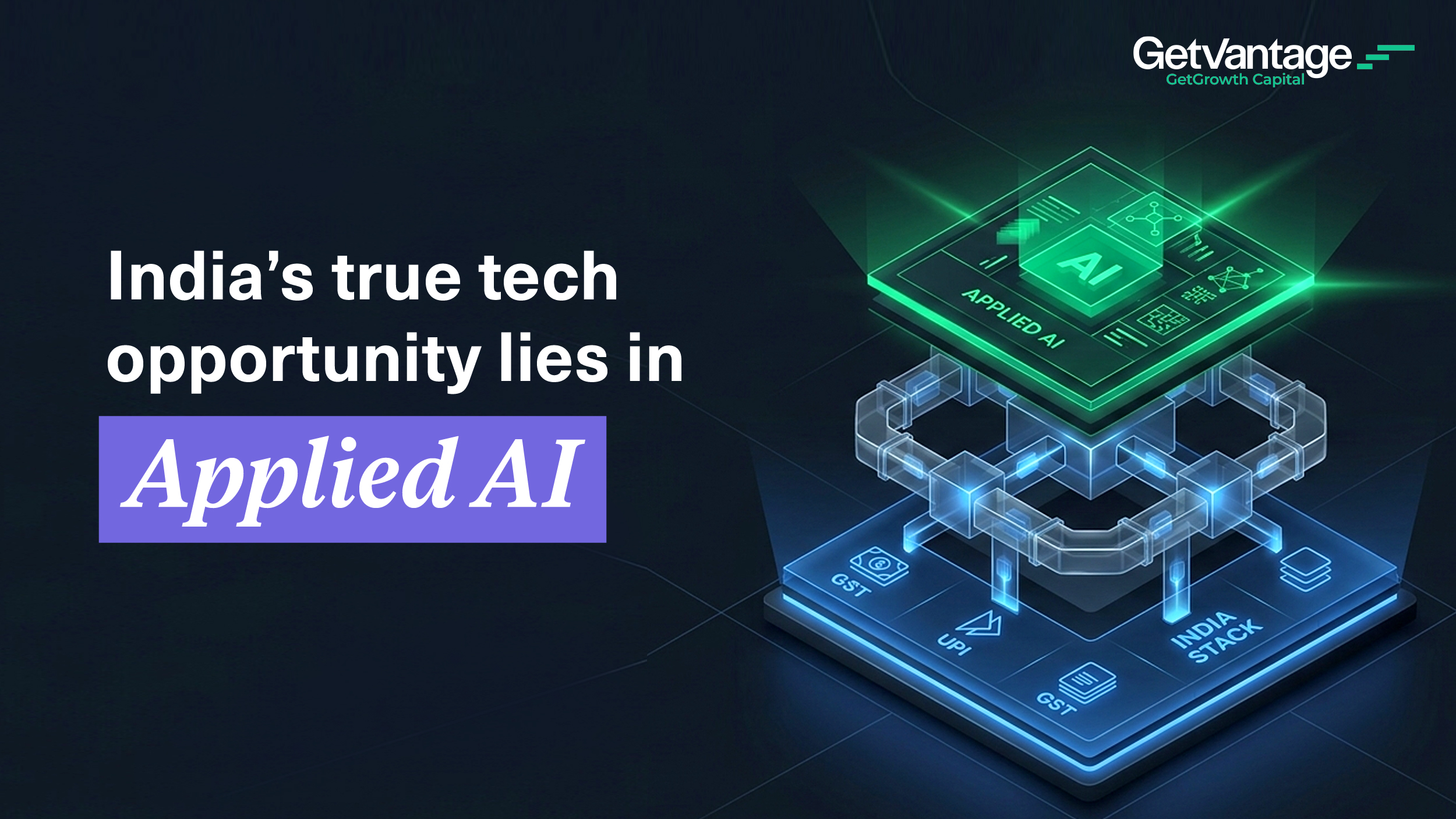
[Raw Transaction Data] ➔ [DPI Frameworks (GST/UPI/AA)] ➔ [Applied AI Engine] ➔ [Instant Credit/Risk Decisions]
Furthermore, compliance requirements like Section 43B(h) of the Income Tax Act, which mandates a strict 45-day payment window clearance for MSME dues, have forced Indian businesses to rely heavily on real-time data tracking for liquidity management.
These systems generate massive volumes of highly structured, verifiable data. Consequently, the core challenge for Indian enterprises is no longer data collection; it is data interpretation. Applied AI acts as the bridge, converting raw payment logs and compliance signals into automated lending, underwriting, and risk assessments.
The MSME Credit Gap Analysed (The Fact-Density Engine)
The Micro, Small, and Medium Enterprise (MSME) sector is the backbone of the Indian economy, driving employment and GDP growth. Yet, access to formal credit remains a structural challenge.
The Data Node: According to reports from the Reserve Bank of India (RBI) and NITI Aayog, India’s MSME credit gap is estimated at ₹20 to ₹25 lakh crore ($530+ billion). Shockingly, fewer than 14% to 20% of MSMEs currently have access to formal credit channels.
The primary cause isn’t a lack of data. It is a legacy underwriting mismatch.
Modern businesses generate continuous digital footprints across GST records, digital payment gateways, and e-commerce platforms. However, traditional credit underwriting engines are still structurally anchored to physical collateral, lengthy manual documentation, and static, historical financial statements.
Digital visibility does not automatically guarantee capital access. The data still requires an intelligent engine to evaluate risk and execute a credit decision in real time.
How Applied AI Transforms Risk Assessment
Traditional legacy banking underwriting requires 3 to 4 weeks of manual documentation review, spreadsheet cross-referencing, and static audits. Modern AI-powered underwriting takes a different approach. By pulling alternative data via Account Aggregators, Applied AI models reduce decision-making latency to under 10 minutes.
Instead of focusing solely on historical, backward-looking statements, AI systems evaluate continuous, real-time operating signals:
- Revenue Consistency & Seasonality: Mapping predictable cash-flow peaks and valleys.
- Transactional Behavior: Monitoring payment velocities and daily banking counterparty interactions.
- Marketplace Momentum: Analyzing merchant performance, inventory turns, and customer review sentiments.
At GetVantage, this thesis powers DDX, an AI-driven underwriting and due diligence engine that evaluates businesses using multiple real-time signals. By pairing digital infrastructure with specialized predictive models, underwriting shifts from weeks to minutes. In fast-moving markets, delayed capital is equivalent to a delayed opportunity. To see this in action, review our breakdown on Modern Revenue-Based Financing and Underwriting.
Why Small Language Models (SLMs) Win in the Enterprise
Answer Capsule: While public attention trends toward parameter-heavy Large Language Models, enterprise workflows are quietly being revolutionized by Small Language Models (SLMs). SLMs are lean, highly optimized AI models trained intentionally for specific vertical tasks like tax compliance analysis, financial procurement, or alternative credit scoring.
The Enterprise Benefits of SLMs:
- Drastically Lower Operating Costs: Reduced token processing fees and lower compute footprints.
- Sub-Second Response Latency: Optimized for high-frequency, real-time automated workflows.
- Enhanced Data Security: Easier to deploy within private cloud environments or on-premise infrastructure.
- High Domain Accuracy: Highly targeted training data minimizes the risk of logical hallucinations.
For India, building hyper-focused SLMs tailored directly to local regulatory and economic workflows is far more practical and high-yielding than competing blindly in the capital-intensive foundational LLM race.
Moving From Embedded Finance to Invisible Finance
The payments revolution proved that friction-free infrastructure wins. Today, the average user transacting via UPI doesn’t consider the underlying banking APIs or routing architecture; they simply complete the transaction.
With the emergence of the OCEN framework and advancements in Applied AI, B2B credit is moving toward a similarly seamless state: Invisible Finance.
Instead of stepping outside their daily operations to apply for external financing, businesses will find capital seamlessly embedded inside the platforms they use to run their operations.
- Underwriting runs autonomously in the background.
- Risk assessment happens continuously rather than at a single point in time.
- Capital deployment aligns dynamically with real-time merchant performance.
Actionable Takeaways for Founders
- Rethink Capital Allocation: Growth funding doesn’t always have to trigger equity dilution. Evaluate performance-based working capital options alongside equity rounds.
- Treat Data as an Asset: Your company’s proprietary transaction loops, supply chain data, and customer interaction logs hold distinct financial value. Protect and structure them.
- Automate Operational Friction: Implement Applied AI models to handle high-frequency, low-complexity compliance and administrative tasks to free up core teams.
The most transformative AI applications don’t look like flashy tech innovations; they look like optimized business outcomes. India’s immediate opportunity isn’t building another general-purpose chatbot. It is applying precise intelligence to the world-class digital rails that already power the physical economy.
Interactive Asset: The Enterprise Applied AI Readiness Audit
To determine if your business is optimized for the shift from generic models to Applied AI workflows, utilize this technical execution checklist:
- [ ] Data Centralization: Are your transactional logs, GST filings, and payment histories aggregated into structured private databases, or are they fragmented across siloed legacy software?
- [ ] DPI Integration: Has your system integrated directly with the Account Aggregator (AA) framework and OCEN protocols to allow consent-based real-time data loops?
- [ ] Model Efficiency: Are you relying on expensive, slow external LLM APIs for structured workflows where a fine-tuned, localized Small Language Model (SLM) could deliver sub-second latency?
- [ ] Risk Infrastructure: Does your credit or compliance engine leverage real-time alternative data streams, or is it still bound to manual quarter-end financial statements?
Watch the Full Insight Strategy Session
Many of these concepts were unpacked by Bhavik Vasa on The Ryan D’Souza Podcast, detailing the evolution of Applied AI, modern MSME credit landscapes, and the growth of embedded B2B finance networks in India.
Watch the full episode here:
Frequently Asked Questions (FAQ)
What is Applied AI?
Applied AI refers to the use of artificial intelligence and machine learning models explicitly designed to solve precise business problems using domain-specific data and structured workflows, rather than general-purpose inquiries.
How is Applied AI different from Generative AI?
Generative AI focuses on open-ended content creation, synthesis, and conversational interactions based on broad public data. Applied AI focuses on enhancing specific business processes, automated workflows, and predictive risk-based decision-making.
Why is proprietary data important for AI?
Proprietary data cannot be easily copied, scraped, or replicated by competitors. Because foundation models are commoditized, an enterprise’s private data serves as its core competitive moat and accuracy engine.
How can AI improve MSME lending?
AI dynamically interprets live digital signals, including GST logs, UPI velocity, and cash-flow cycles, to create real-time risk profiles, enabling faster and more accurate credit allocation than manual paper-based reviews.
What is AI underwriting?
AI underwriting uses machine learning algorithms and real-time alternative data points to assess an applicant’s creditworthiness and financial risk profile automatically, cutting approval times from weeks to minutes.
What is OCEN?
OCEN stands for the Open Credit Enablement Network. It is a shared digital protocol in India that connects digital platforms (marketplaces, tech providers) directly with credit institutions, allowing frictionless, embedded lending.
What are Small Language Models?
Small Language Models (SLMs) are compact, highly targeted AI models optimized for specific domains or vertical tasks. They offer faster response times, lower compute costs, and higher accuracy for specialized enterprise operations.
Why is India well-positioned for Applied AI?
India possesses a unique, population-scale Digital Public Infrastructure (DPI), including UPI, GST, Aadhaar, OCEN, and the Account Aggregator framework. This ecosystem generates vast quantities of clean, verifiable digital data ready for AI applications.