For most Indian founders, applying for a business loan feels like stepping into a time machine.
Your day-to-day operations are hyper-digital. You acquire customers via live ad auctions on Meta, process revenue through Stripe or Razorpay, manage inventory on Shopify dashboards, and keep books on Zoho Books. Your business moves in real-time.
Yet, when you need capital to scale, you are asked for physical documents, historical tax filings, and personal guarantees. You are forced through a manual underwriting process that takes weeks, only to receive a rigid product with fixed monthly repayments that don’t care about your seasonal sales cycles.
This is the central problem: Legacy business loan products are static. Your digital business is dynamic. They are fundamentally incompatible.
The era of embedded finance is changing this, giving rise to the Capital Gateway.
In this article, we’ll explain why the old model fails modern MSMEs and why programmatic capital flow is the inevitable future of business finance in India.
Why is a traditional business loan a bad fit for my modern business?
Traditional lenders (banks and legacy NBFCs) operate under a “snapshot” philosophy. They take a backward-looking glance at your business from months or years ago to make a decision about your future.
According to SIDBI’s MSME Outlook survey for FY2024, despite improved credit flow, there is a massive lending opportunity, an addressable credit gap estimated at ₹30 lakh crore in India’s MSME sector. Why? Because the standard snapshot doesn’t capture the reality of a modern digital business.
This approach creates severe pain points for Indian founders:
Disconnected data creates friction
Lenders still require you to manually collect and present data. You spend days exporting PDFs and reconciling bank statements because their archaic underwriting systems cannot “talk” to your operating stack.
Forward-looking growth vs. backward-looking underwriting
A loan approval decided today based on your FY23 financial records is useless for a high-growth startup that just doubled its sales last month. Static underwriting ignores the current velocity of your business.
Rigid repayments strain your cash flow
A fixed loan requires fixed Equated Monthly Installments (EMIs). If your e-commerce store does ₹50 lakh in sales in Diwali (November) but only ₹15 lakh in January, that fixed EMI in January creates critical cash flow strain when you can least afford it.
What exactly is a Capital Gateway, and how does it work?
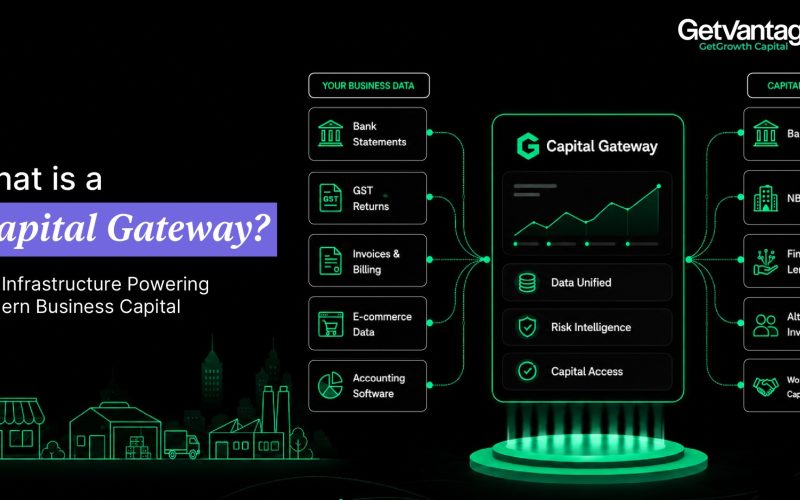
A Capital Gateway represents the digitalization of underwriting. It is a technological layer that connects a business’s operational data directly to institutional capital providers.
Think of it as a financial router. Just as a payment gateway (like Razorpay) routes transactional tokens securely, a capital gateway programmatically manages liquidity flow based on real-time metrics.
Instead of manual applications, a Capital Gateway operates “under the hood” through three sequential steps:
- Multi-Channel Data Ingestion: It connects via read-only APIs to your revenue channels, commerce engines, and accounting tools.
- Live Risk Scoring: An AI-native risk engine continuously analyzes metrics like sales velocity, Customer Acquisition Cost (CAC) efficiency, and customer churn. This provides a live assessment of your business health.
- Programmatic Matching: The system routes your funding requirement to the optimal capital partner, deploying liquidity based on current performance, not past records.
How do I compare a regular business loan with a modern Capital Gateway?
To make it easy, here is a simple breakdown of how the two models function side-by-side.
| Dimension | Traditional Business Loan | Modern Capital Gateway |
| Data Underwriting | Manual, historical PDFs & tax filings (Static) | API-integrated, live operational telemetry (Dynamic) |
| Approval Speed | Weeks (Manual review) | Minutes/Hours (AI-driven analysis) |
| Security Needed | Asset collateral, personal guarantees | None (based on performance metrics) |
| Repayment Model | Fixed monthly payments (EMI) | Flexible, revenue-aligned (e.g., % of daily sales) |
| Cost Transparency | Often complex with hidden processing fees | Usually a clear, flat fee on the principal |
Where can I find examples of Capital Gateways in India?
The shift toward this dynamic model is already visible. Some companies integrate lending directly, while others are specialized gateways.
- Payment & Subscription Distribution: Paytm uses transaction telemetry from its Soundbox and POS devices to partner with financial institutions and distribute working capital loans that merchants repay daily from their incoming settlement.
- Platform-Specific Lending: In Western markets, Shopify Capital or Stripe Capital offer embedded financing based on their own ecosystem data.
- Pure-Play Capital Gateways: Specialized platforms (like GetVantage) function as independent infrastructure layers. These gateways connect to multi-channel environments (Stripe + Shopify + Zoho + Amazon) to route optimized capital structures like revenue-based financing or inventory funding.
Why is my dynamic digital business better served by a Capital Gateway?
A business loan application is a broken process where data must be manually extracted, verified, and submitted. It is a static answer to a dynamic question.
A modern enterprise needs Capital Gateway infrastructure that integrates dynamic capital access directly into daily operations. For an Indian founder scaling a friction-free business, the path forward isn’t through another loan application; it is through a capital gateway.
Capital Gateway vs Business Loan FAQ
1. What is the main difference between a Capital Gateway and a regular business loan?
A traditional business loan requires historical paperwork, manual underwriting, and fixed monthly repayments (EMIs). A Capital Gateway is modern fintech infrastructure. It connects to your business software APIs (like Shopify, Stripe, Zoho) to use live data for faster approvals and flexible, performance-aligned funding options.
2. Can I get a Capital Gateway if my startup doesn’t have collateral?
Yes. Capital Gateways typically route non-dilutive, unsecured growth capital tailored to modern business models. Instead of physical assets or personal guarantees, they use AI engines to analyze your live sales velocity, CAC efficiency, and cash flow consistency as security.
3. How fast can I access funding through a Capital Gateway?
While a bank loan application might take weeks or months, funding through a Capital Gateway can often be approved and deployed within minutes or hours. This is because they replace manual review with automated risk engines that continuously score your integrated data stack.
4. What types of funding products are available through a Capital Gateway in India?
A Capital Gateway programmatically connects you to several modern financing structures. The most common in India include Revenue-Based Financing (RBF), dynamic working capital lines, inventory funding, and purchase order financing.
5. Why should a founder choose a Capital Gateway over a traditional NBFC loan?
Traditional static loans from NBFCs often strain cash flow with fixed payments during slow months. A Capital Gateway offers dynamic liquidity that scales with your growth and features repayments aligned directly with your daily sales, ensuring you only pay more when you earn more.