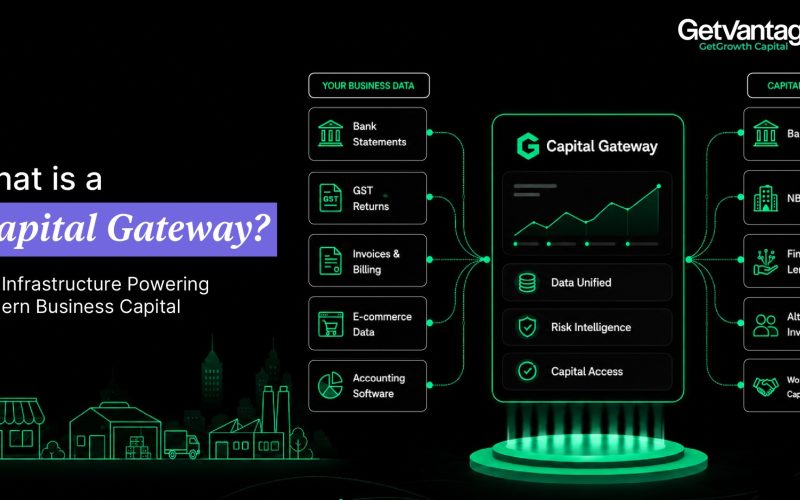
In the early days of online commerce, accepting payments from customers was a complex engineering challenge. Merchants had to build direct, custom integrations with legacy acquiring banks, handle strict security protocols, and manage manual reconciliation.
That changed with the rise of Payment Gateways, pioneered by global infrastructure giants like Stripe, Adyen, and PayPal. By providing standardized, API-driven software rails, payment gateways abstracted away bank complexity, allowing businesses to accept payments anywhere in the world with a few lines of code.
Today, a similar transformation is happening on the other side of the balance sheet.
While payment gateways revolutionized how businesses collect money from customers, a new class of B2B fintech infrastructure is transforming how businesses access growth funding.
This shift is giving rise to the Capital Gateway – a programmatic layer that connects operating platforms with institutional capital.
In this article, we break down the fundamental mental model comparing payment gateways to capital gateways, analyze how global and regional platforms are adopting this architecture, and explain why programmatic liquidity is becoming a core component of modern business software.
The Mental Model: Inbound Collections vs. Outbound Liquidity
To understand a capital gateway, it helps to start with the tool every digital business uses daily: the payment gateway.
- Payment Gateway: Acts as an API-first bridge connecting a merchant’s checkout stack to payment networks (Visa, Mastercard, UPI) and issuing banks. Its core function is handling inbound transactional cash flow.
- Capital Gateway: Acts as an API-first software layer connecting a business’s operational stack to institutional capital providers and credit markets. Its core function is routing outbound growth liquidity.
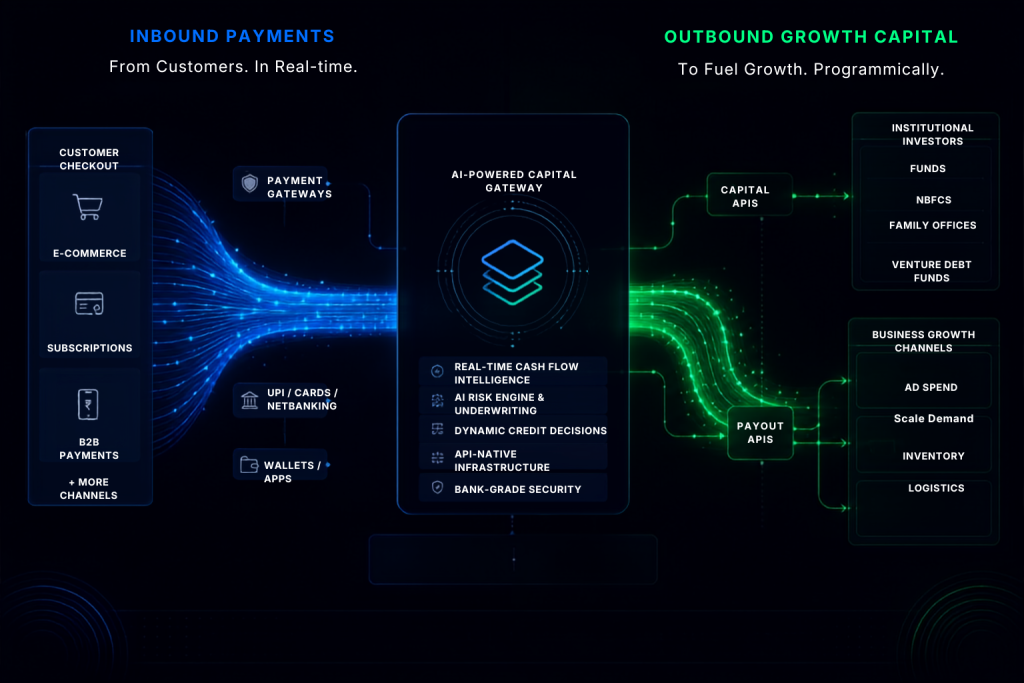
Rather than forcing businesses through manual bank underwriting or rigid equity rounds, a capital gateway treats funding as a programmatic data request, evaluating live operational telemetry to deploy instant working capital.
Key Differences Breakdown
While both architectures rely on secure APIs, cloud infrastructure, and real-time data processing, their underlying mechanisms serve two entirely different financial functions:
| Dimension | Payment Gateway | Capital Gateway |
| Primary Function | Processes inbound sales payments | Routes non-dilutive growth capital |
| Core Technology | Payment processing APIs & webhooks | AI-native underwriting & data ingestion engines |
| Data Sources | Credit cards, bank accounts, digital wallets | ERPs, billing tools, platform GMV, POS devices, accounting software |
| Financial Counterparty | End customers / Buyers | Institutional credit funds, banks, liquidity partners |
| Risk Focus | Fraud prevention & chargeback detection | Real-time cash flow analysis & credit performance forecasting |
| Repayment Model | Immediate per-transaction fees | Dynamic, performance-aligned revenue sharing |
The Global Shift Toward Embedded Capital Infrastructure
The evolution from simple payment processing to comprehensive capital distribution is being driven by technology leaders across the global software ecosystem. Recent market data shows the global embedded finance market reaching $149 billion, with forecasts projecting growth past $1.3 trillion over the next decade. Modern enterprise platforms recognize that offering embedded financing increases gross merchandise value (GMV) and improves user retention.
Different players in the global ecosystem approach this challenge through varying models:
- Platform-Specific Capital Programs: Companies like Shopify (Shopify Capital) and Stripe (Stripe Capital) have built embedded lending features directly into their proprietary ecosystems. While effective for merchants operating inside those platforms, these solutions are typically limited to single-platform payment data. (For perspective, Stripe processed $1.9 trillion in payment volume, highlighting the sheer volume of merchant revenue data flowing through digital gateways).
- Merchant Ecosystem Distribution: In regional markets, platforms like Paytm demonstrate the power of combining payment acceptance with financial distribution. With over 13 million merchant subscription devices (Soundboxes and POS systems) active in the market, Paytm uses daily transaction telemetry and merchant engagement history to partner with financial institutions and distribute daily-repayment working capital loans.
- Specialized Infrastructure & Pure-Play Capital Gateways: Global platforms like Parafin and Capchase in Western markets, along with GetVantage across emerging markets, function as dedicated, independent infrastructure layers. These gateways aggregate real-time data from multi-channel environments, including payment gateways, accounting platforms, ERPs, and marketplace channels, to route optimized capital structures (such as cashflow-based financing, inventory funding, and SaaS runway extension).
By operating as an independent, multi-funder software layer, a capital gateway decouples business financing from rigid single-lender balance sheets.
How a Capital Gateway Operates Under the Hood
Just as a payment gateway routes authorization tokens between a buyer and an acquiring bank, a capital gateway programmatically manages three sequential operations:
1. Multi-Channel Data Ingestion
Instead of requiring PDF bank statements or historical tax filings, the gateway connects via read-only APIs to the business’s tech stack, including payment gateways (Stripe, Razorpay, Paytm), commerce engines (Shopify, WooCommerce), and accounting tools (QuickBooks, Zoho Books).
2. Live Operational Telemetry & Risk Scoring
An AI-native risk engine continuously analyzes metrics like sales velocity, customer acquisition cost (CAC) efficiency, subscription churn, and net revenue retention. This provides an accurate, real-time assessment of business health, replacing static credit bureau ratings.
3. Programmatic Capital Matching
Once qualified, the system routes the funding requirement to the optimal capital partner. Because the gateway integrates directly with the business’s revenue channels, repayments occur dynamically as a flexible percentage of daily or weekly sales.
Why Modern Enterprises Need Both Rails
For modern businesses, payment processing and capital access are two sides of the same operational coin.
A payment gateway ensures that every dollar earned from a customer is captured securely and efficiently. A Capital Gateway ensures that when a company identifies a growth opportunity, whether scaling ad spend, purchasing inventory, or extending software runway, the necessary liquidity can be requested, approved, and deployed without friction or equity dilution.
As B2B fintech continues to mature, the capital gateway is transitioning from an innovative funding alternative into an essential layer of modern digital financial infrastructure.
Frequently Asked Questions (FAQ)
1. What is the difference between a payment gateway and a capital gateway?
A payment gateway processes inbound transactions from customers to a business (handling revenue collection). In contrast, a capital gateway routes outbound non-dilutive growth capital from institutional financial providers to a business (handling liquidity distribution) by using real-time operational data.
2. Is a capital gateway a balance-sheet lender or NBFC?
No. A capital gateway operates as a technology and distribution infrastructure layer rather than a direct balance-sheet lender. It functions like a software router, programmatically connecting business operating stacks to external institutional credit partners, banks, and liquidity providers.
3. How does a capital gateway evaluate a business for funding?
Instead of relying on static credit bureau scores, personal guarantees, or physical collateral, a capital gateway uses API integrations to analyze live operational telemetry. An AI-native risk engine evaluates metrics like sales velocity, customer acquisition cost (CAC) efficiency, platform GMV, and real-time cash flow consistency.
4. What types of funding products pass through a capital gateway?
A capital gateway routes non-dilutive growth capital structures tailored to modern business models. These include revenue-based financing (RBF), inventory and purchase order funding, SaaS runway extension, seller financing, and dynamic working capital lines.
5. Can a business use a payment gateway and a capital gateway at the same time?
Yes. Payment gateways and capital gateways handle two opposite sides of a company’s financial operations. A payment gateway ensures customer revenue is collected securely, while a capital gateway uses data from that payment processing stack to deploy growth capital when the business needs liquidity.